
Symptoms as Obstacles

Design composed of girl profile colorful fractal butterfly patterns and abstract lights on the subject of beauty creativity and imagination

I have ADHD. I’m sure I’ve always had it, but got diagnosed at 40 because I was tired of working so hard when focusing on things seemed easy for others. Since then, I’ve been on a daily medication, that helps quite a bit. I can focus on one thing for 90 minutes, which was nearly impossible before.

When you have symptoms of any disorder, or medical condition, that is your obstacle to overcome. Some things are overcome by medicine, others habits or routines, and some things will just be a struggle. But it is yours to overcome, and not an excuse for a lack of trying.

For example, let’s say you have asthma. Running a marathon may be a poor choice for you, and you should work with your body to do what makes sense. But if running a marathon was your life’s ambition, you might discuss it with your doctor, work up the stamina to run longer distances over time, and still carry your rescue inhaler. Your obstacle to work around is sustained lung capacity – which your body may or may not tolerate.

Since this is a mental health blog, let’s say instead that you have bipolar disorder which causes your mood to be both depressed then elevated with impulsivity. One way to balance that out is a mood stabilizer. You might also track your mood in a journal or on an app so you are prepared for when the manic phase is coming. Since you are impulsive when manic, you might give your credit cards to a trusted person during those days so you don’t overspend. Your obstacle is to work around the impulsivity and know when the manic phase will be arriving by tracking your mood.

Back to my ADHD example, I hate a task before a task. It takes an amount of executive function to begin a task that can be difficult to summon, so putting another in the way is frustrating and can make me want to quit. I know that my medication starts to wear off by 7pm, so I do well to get those high-executive-function tasks out of the way before then. A way this often comes up is in cleaning the cat box. I have to sweep the hall and laundry room of cat litter before I can get to the box. Sometimes I have to only sweep, and come back later to do the box. I can’t just not clean the box, so blaming ADHD is insufficient. I have to work around the obstacle of task-before-a-task frustration by separating it into two discrete tasks, and doing it before it is late in the evening.

Everyone has different obstacles, even within the same symptoms or diagnoses. That’s why cookie-cutter therapy does not work. We have to determine, for you, your obstacles, and how to help you work around them with grace.

Autumn Hahn is a Licensed Mental Health Counselor, Licensed Clinical Professional Counselor, and Certified Clinical Hypnotherapist practicing at Clear Mind Group in Florida, Georgia, Idaho, Nevada, New York, and Virginia. Call 407-494-5280 for a consultation. Follow Clear Mind Group on Twitter & Facebook.

Toxic Positivity

Order this neon work from Neon Mama.

If someone could just feel better, they would. For everyone else, there’s therapy. Telling people to think positively is as ridiculous as telling someone to “Just wish your broken arm away.” Positivity becomes toxic when it fails to account for the reasoning or dismisses the person’s feelings. Sometimes, the vibe is just bad, and that’s okay, too. We don’t have to be happy all the time. Perhaps the meaning of life is to feel everything; either way, life has highs and lows. We need to learn to cope with the lows and get through them without self-destructing or exploding, but we can honor the part of us that is hurting, too – and we can honor that in others, allowing them the space to get through the hard times with our support, not our positivity.

The mind is negatively skewed to ensure our safety. If we think the stick is a snake, we will be wary, but if we always assume it is a stick, sometimes we will be bitten. We’re meant to think negatively, but that does not mean we are meant to be depressed or to remain in a low state. There is a reason or a time for being down, and a reason and a time for being up. Getting back up can be hard, but it is practical. In an up-state, a good vibes time, we can appreciate things in a way that we cannot in a depression. If this is too difficult to do alone, there is therapy, medication, hospitalization, outpatient programs, exercise, music, sunshine, and a balanced diet. Balance is difficult to find, but you can do it. I, for one, am here to help.

Autumn Hahn is a Licensed Mental Health Counselor, Licensed Clinical Professional Counselor, and Certified Clinical Hypnotherapist practicing at Clear Mind Group in Florida, Georgia, Idaho, Nevada, New York, and Virginia. Call 407-494-5280 for a consultation. Follow Clear Mind Group on Twitter & Facebook.

Mother’s Day, Father’s Day, Arbor Day

Holidays are conflicted for many people. Mother’s Day and Father’s Day, in particular, are especially hard because of the complicated relationships we often have with our parents, our children, our grandparents, and the history of those days. It can be painful to see commercials celebrating seemingly perfect parent-child relationships, receive texts and calls, and feel obligated to see family.

Here’s the solution: Treat these days like Arbor Day. You know, Arbor Day, when you’re supposed to…worship trees like a druid? Plant trees? I don’t know. But we never even notice it passing on the calendar. Let this be that. Take those texts in like “Happy Arbor Day!” and those invitations like “Let’s celebrate Arbor Day together” oh, no thanks. Switch the words in your head and eliminate some of the heaviness.

Autumn Hahn is a Licensed Mental Health Counselor, Licensed Clinical Professional Counselor, and Certified Clinical Hypnotherapist practicing at Clear Mind Group in Florida, Georgia, Idaho, Nevada, New York, and Virginia. Call 407-494-5280 for a consultation. Follow Clear Mind Group on Twitter & Facebook.

After a Suicide Attempt – for the Loved Ones

Meeting Of Support Group

You care about someone who recently attempted suicide. What is your role now? How can you be supportive, helpful, and useful to them? Should you pretend it never happened, or follow up? Will talking about it make them more likely to try again? These are difficult waters to know how to navigate.

They’re experiencing a lot of feelings right now, and may not be able to ask for – or know – what they need. They may feel like a burden to others and feel unable or unwilling to ask for what they need. To get another perspective, here is an article for the attempter.

Be available as much as you can, and check in. The rate at which to do this depends on your existing relationship. Do what feels comfortable, and maybe 1/2 a step more. You are not expected to have a perfect solution or fix anything. Ask how they’re feeling, sleeping, eating, and what they’re thinking. Skip the platitudes like “everything happens for a reason” and “there must be a purpose you’re still here” as they feel hollow to receive and don’t create lasting change or connection.

Sort out your own feelings by talking to a therapist of your own, the family support staff at the hospital or agency where your loved one is being seen, or a trusted friend who will keep confidential what has happened. You can still lean on your loved one, but they can only give you back so much right now as they deal with their own stuff, so keep your portion lighter than theirs for the time being, but don’t withdraw, either, or be afraid to talk about some of your struggles. They likely don’t want interactions to feel phony, surface, or like others cannot be themselves – this can lead to guilt. If you have guilt, sort through it knowing that a person has to be at a personal low in order to make an attempt, and your part in that, if any, was only a part, and there are more pieces that created the depth of pain. Despite your curiosity, do your best to avoid asking them why they made the attempt as expressing the level of pain it took to try to escape it may be impossible to verbalize; do encourage them to discuss it in therapy, though any decent therapist will be exploring this.

Ask what you can do to help. This could be: making some meals and dropping them off to be heated up later, helping them get clothing or makeup to cover the healing wound, just sitting together, or checking in on them by text daily. Sometimes they want to be left alone, and if it is safe to do so, respect that request, and make the offer. Make plans for the future, something to look forward to – a restaurant you haven’t tried yet, a return to a fun activity, a small trip.

It’s okay to ask if they feel suicidal, or are having thoughts, urges, or a plan to kill themselves. Of course, making that every interaction would be annoying to anyone, but asking does not increase suicidality. You could also ask what the plan is if those feelings/thoughts return, and have a ready plan in place (mobile crisis unit, hospital, psychiatrist, therapist, who they will tell, if not you). It is relevant to know that suicidal thoughts are just thoughts, but urges and plans are more serious and safety actions can be mobilized at those later steps.

Be patient with them and with yourself as you each work through this. This part is going to suck for everyone. You’re enduring it together so you can all get through it.

Autumn Hahn is a Licensed Mental Health Counselor, Licensed Clinical Professional Counselor, and Certified Clinical Hypnotherapist practicing at Clear Mind Group in Florida, Georgia, Idaho, Nevada, New York, and Virginia. Call 407-494-5280 for a consultation. Follow Clear Mind Group on Twitter & Facebook.

After a Suicide Attempt – for the Attempter

treenage girl suffering with depression in a conversation with therapist or psychologist

You’ve been in a low point and it took you as far as you could go, so far that you felt ending things was the only way to get out of your misery. And it didn’t work. Maybe you were intercepted or your method wasn’t effective or executed in the right way. You’re going to have a lot of feelings interspersed with feeling nothing at all. This is normal, if anything can feel normal right now.

You might feel anger at your choices, your method, those who intervened, or God. You might feel worthless for failure at the attempt that was unsuccessful. You might feel just as (or more) sad, lonely, or depressed than you did before the attempt. You might feel guilty over the fallout to your loved ones, or inability to provide. You might feel numb, hollow, or empty – this one is especially tough as it is a protective factor, but means you cannot absorb any good feelings being sent your way during these times. Whatever you’re feeling, it’s okay. If you’re feeling something, that’s positive. Here’s the thing to note: feelings change. If you can feel this, you can feel something positive – maybe not today, but there can be hope. You’ve felt good feelings before, even if not recently, and you can feel good feelings again.

Please don’t try to do this in isolation. Maybe you can, but you don’t have to, and it’s too hard to try. When everything else is already so hard, let this part be easier. There’s hospitals for inpatient help if you need to be monitored for additional attempts and need round-the-clock care (search “psychiatric receiving hospital near me” and read the reviews to choose one), outpatient services like therapy (there’s different levels of therapy like weekly or multiple times per week, in person and online) and psychiatry. Psychiatrists prescribe medications, and it’d probably be good to look into this as your chemicals are likely lacking in one direction or another and need servicing like your car needs proper gas. I’d advise you to tell one person close to you about your attempt. Maybe someone already knows, or multiple people do. It’s okay to share as much as you’re comfortable with with these people and half your burden. Therapy is a great outlet for this, in addition, but do lean on your loved ones as they want to help you through this.

How do you get back to living? Do you just pretend everything’s fine? That’s too much effort. Be where you are. Take a break as much as you can. Step back in gently. Do a bit of work. Do a bit of hygiene. Do a bit of housework. The stuff that makes life feel normal, do some of it. If the house is still a mess, that’s okay, too. But spending 5 or 15 minutes doing the dishes or making a dentist appointment is what life is, that little stuff. And by gently, I mean even if you spend 15 minutes washing the same dish while zoned out, that’s okay. It’s still one dish down. Sometimes you have to plod along, and this is that transition point. Get by and get through.

Autumn Hahn is a Licensed Mental Health Counselor, Licensed Clinical Professional Counselor, and Certified Clinical Hypnotherapist practicing at Clear Mind Group in Florida, Georgia, Idaho, Nevada, New York, and Virginia. Call 407-494-5280 for a consultation. Follow Clear Mind Group on Twitter & Facebook.

Ways to Self-Soothe

You’re having a bad day due to anxiety, depression, or just the general stress of being a human on this modern earth. You want ways to calm yourself when the things you know to try aren’t successful. Try these:

Pet an animal, real or stuffed, or a soft blanket, or a cozy sweater.

Sip a warm beverage, any that you enjoy (but you might skip the caffeine) like cocoa, tea, or coffee. You don’t have to follow Big Bang Theory’s protocol.

Take a warm shower or soak in the tub. Bonus if you have bubbles or something to add a pleasant scent. You don’t have to cleanse if you’re already clean, but bringing your core temperature up can be helpful.

Write or do art. Getting your emotions out of your body and onto the page can release pent up feelings. What you write/create makes no difference as it’s about expression, not creating something wonderful right now.

Move your body gently and briefly is fine. Take a walk around the block, dance to one song, check out some tai chi, or whatever you like best.

Massage your muscles by rolling your neck, using a foam roller, or rubbing your body with your hands.

Spend time in nature by visiting a local park, or even sitting on your porch and looking at the plants and creatures nearby.

What other tips do you enjoy that I haven’t listed?

Autumn Hahn is a Licensed Mental Health Counselor, Licensed Clinical Professional Counselor, and Certified Clinical Hypnotherapist practicing at Clear Mind Group in Florida, Georgia, Idaho, Nevada, New York, and Virginia. Call 407-494-5280 for a consultation. Follow Clear Mind Group on Twitter & Facebook.

Why me? and It’s not fair.

person walking in rain with red umbrella at night

When a traumatic event happens, most people are left with the question “Why me?” and the feeling of “It’s not fair.” What do you do with those and how do you move beyond the stuck feeling they leave you?

It’s not fair. No, it’s not. Much of real life isn’t fair and this thing is also not fair. There’s no making it fair. There’s no making it right. It was a terrible thing and it doesn’t have to be better or make sense or fit in with an idealized version of reality. Some things just suck and this is one of them. It’s okay that this is how it went down. Fighting the unfairness of it is futile. Allow it to be unfair and you’ll stop coming up against this obstacle.

Why me? No reason, or maybe some reason that isn’t useful to speculate. People do terrible things. Sometimes they’re terrible people, and sometimes not, but done is done. It sucks that it happened to you. Crappy things happen to people all the time and you’re one of the people that had a crappy thing (or series of crappy things) happen to them. Spending your energy trying to solve this is a wasted time.

I get that that this doesn’t sound positive or hopeful. I’m not trying to be a ray of sunshine as I think that’s too far from the truth and wouldn’t be useful anyhow. If you are throwing yourself against these walls and stuck on them, the way past them is through understanding that they don’t have to be fixed to be understood. This is only one piece of the healing, but it’s a crucial piece if its a place where you’re repeatedly finding yourself.

Autumn Hahn is a Licensed Mental Health Counselor, Licensed Clinical Professional Counselor, and Certified Clinical Hypnotherapist practicing at Clear Mind Group in Florida, Georgia, Idaho, Nevada, New York, and Virginia. Call 407-494-5280 for a consultation. Follow Clear Mind Group on Twitter & Facebook.

Be Here Now

Have you been feeling unmoored from your body, your sense of self, or your life? Do you feel adrift, unhinged, untethered, or in need of grounding? Have you been spinning out of control in your thoughts and unable to gain traction?

Try this mantra: “Be here now.” But say it like each word is a sentence: Be. Here. Now.

With each word, do it.

Be. Be in your body. Notice your body, the weight of it, the position it is in, the feeling of any fabric or material on your skin, and any movement of the air.

Here. In this place. Where you are, with anything you can notice around you, eyes open or closed. Engage your senses: see, hear, smell, taste, feel – to notice absolutely anything.

Now. In this moment, the only moment that exists, present as best you can, eliminating thoughts of past and future as best you can right now. It might be difficult and that’s okay; just do your best and reset and reset again if you need to.

Autumn Hahn is a Licensed Mental Health Counselor, Licensed Clinical Professional Counselor, and Certified Clinical Hypnotherapist practicing at Clear Mind Group in Florida, Georgia, Idaho, Nevada, New York, and Virginia. Call 407-494-5280 for a consultation. Follow Clear Mind Group on Twitter & Facebook.

Winter Blues

Winter landscape branches form a heart-shaped pattern

Clients at my practice have shown an increase in depressive symptoms in the past month. This is typical for this time of year. The decrease in sunlight causes the Winter Blues, or technically, Seasonal Affective Disorder (SAD).

Our brains are dependent on chemicals from sunlight to create the happy chemicals. You may have noticed you are feeling more: sad, irritable, grumpy, touchy, or frustrated this month. If this is you, make an effort to get more sunlight. Sit outside during lunch. Go for a short walk before work. Anywhere you can get an extra 20-40 minutes of sunlight will be an improvement.

Autumn Hahn is a Licensed Mental Health Counselor, Licensed Clinical Professional Counselor, and Certified Clinical Hypnotherapist practicing at Clear Mind Group in Florida, Georgia, Idaho, Nevada, New York, and Virginia. Call 407-494-5280 for a consultation. Follow Clear Mind Group on Twitter & Facebook.
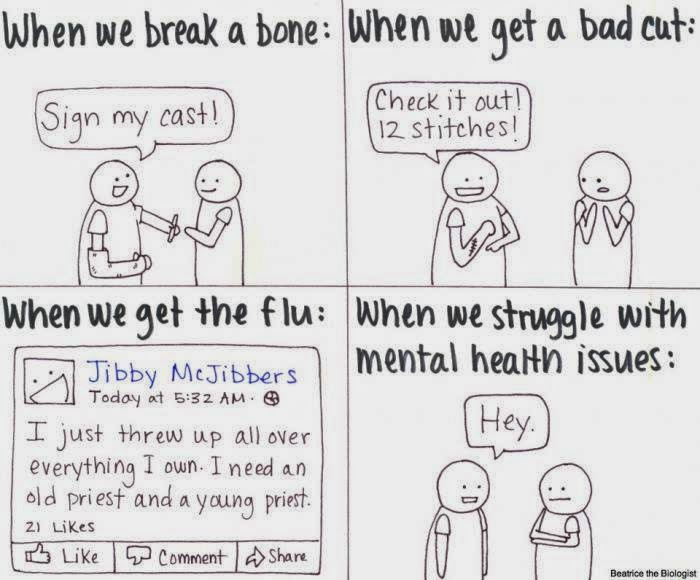
Talk About Mental Health

0MH
by Beatrice the Biologist

For hundreds of years, mental health has long been talked about in hushed tones.

Is it any wonder, when we started out treating it as possession by evil spirits? Ancient skulls have been found with holes knocked in them to let out the demons. If this was the method of treatment, I’d keep any abnormal thoughts to myself, too, to avoid having to “get better” that way. Continue reading “Talk About Mental Health”